


You’ve published blog posts, updated your website, and even followed a few SEO tips.
And yet — your website still isn’t ranking.
This is one of the most common frustrations small business owners face. Not because they aren’t trying, but because SEO isn’t failing due to lack of effort. It’s failing due to foundational mistakes that quietly undermine everything else.
Below are the most common small business SEO mistakes that stop websites from ranking — even when content exists — and what to do instead.
If Your Small Business Website Is Not Ranking, You’re Not Alone
Many small business websites struggle with visibility, even after months (or years) of publishing content.
The issue usually isn’t “Google doesn’t like my business” or “SEO doesn’t work anymore.”
It’s that SEO is often treated as a task, not a system.
SEO works best when your website, content, structure, and user experience are aligned. When they are not, rankings stall no matter how often you publish.
The Real Problem: Small Business SEO Mistakes, Not Lack of Content
One of the biggest misconceptions is that SEO success comes from “posting more.”
In reality, many small business websites have content , but:
- It isn’t strategic
- It isn’t structured
- It isn’t connected to a larger goal
Let’s look at the specific mistakes that cause this.
7 Small Business SEO Mistakes That Stop Your Website from Ranking
1. No Clear SEO Strategy or Keyword Focus
Publishing content without a clear keyword or page purpose is one of the biggest SEO mistakes.
When every blog post targets a different idea — or no idea at all — Google has no clear understanding of:
- What your site is about
- Which pages matter most
- What you should rank for
What works instead:
Every page should have:
- One primary focus
- A clear role within your site
- A connection to a broader topic or pillar
SEO momentum comes from direction, not volume.
2. Creating Content Without Search Intent
Not all content is meant to rank — and not all content should.
A common issue is writing blog posts that are interesting but misaligned with what people are actually searching for. For example:
- Educational content that never answers a real query
- Brand stories written as blog posts
- Topics chosen based on inspiration, not intent
What works instead:
Before writing, ask:
- Is this informational, commercial, or transactional?
- What problem is the reader trying to solve?
- Does this page clearly answer that problem?
Search engines prioritise usefulness, not creativity alone.
3. Weak Website Structure and Navigation
SEO doesn’t happen in isolation — it relies heavily on site structure.
When your website has:
- No clear hierarchy
- Pages buried several clicks deep
- Blog posts that don’t link to anything meaningful
Google struggles to understand which pages are most important.
A strong structure includes:
- Clear navigation
- Pillar pages supported by related posts
- Intentional internal linking
This helps both users and search engines move through your site with ease.
4. Ignoring On-Page SEO Basics
Small details compound over time — and skipping them adds up.
Common on-page SEO mistakes include:
- Missing or duplicated title tags
- Weak or generic meta descriptions
- Incorrect heading structure
- Images without alt text
Individually, these seem minor. Collectively, they weaken your site’s ability to rank.
Treat on-page SEO as part of your design process — not an afterthought.
5. Slow, Outdated, or Not Mobile-Friendly Design
Google evaluates how users experience your website — not just what it says. This is why small business website design must prioritize speed and mobile experience from the ground up, not as an afterthought.
If your site is:
- Slow to load
- Hard to navigate on mobile
- Visually cluttered or confusing
Users leave quickly, and rankings suffer as a result.
What works instead:
SEO-ready websites prioritise:
- Speed
- Mobile responsiveness
- Clarity and ease of use
Design and SEO are not separate disciplines — they support each other.
6. Thin Content and Lack of Topical Authority
Publishing one or two posts on a topic rarely leads to strong rankings.
Google favours websites that demonstrate depth, not just presence.
Thin content often looks like:
- Short posts that barely answer the question
- Isolated articles with no related content
- Topics that are never expanded on
What works instead:
Build authority through:
- Pillar content
- Supporting articles
- Clear topical clusters
This signals expertise and trust over time.
7. Poor User Experience That Hurts Credibility
Even technically “correct” SEO can fail if the experience feels off.
Signs include:
- Confusing layouts
- Inconsistent branding
- Hard-to-find information
- No clear next step for the user
If users don’t trust your site, neither will search engines.
What works instead:
An intentional user experience builds credibility — and credibility supports rankings.
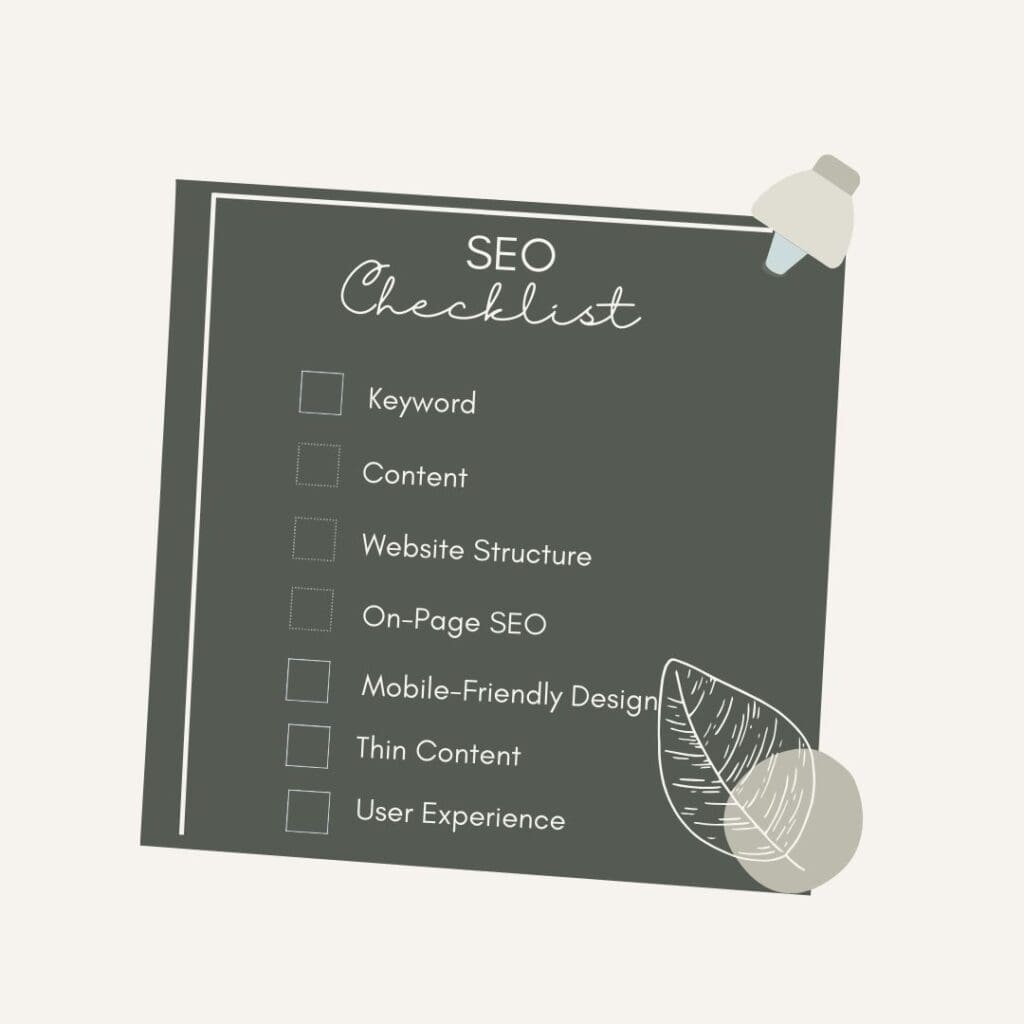
Why These SEO Mistakes Lead to “My Website Is Not Ranking”
When these mistakes stack up, the result is predictable:
- Google can’t clearly categorise your site
- Users don’t stay long enough
- Content lacks direction and authority
SEO isn’t broken — it’s just unsupported.
How to Fix a Small Business Website That’s Not Ranking

If your website isn’t ranking, start here:
- Start with my complete small business SEO guide for a strategic framework
- Audit your existing pages and content
- Clarify which keywords and topics matter most
- Improve site structure and internal linking
- Strengthen on-page SEO fundamentals
- Upgrade design, speed, and mobile experience
- Build content around pillars — not random posts
Most importantly, treat SEO as a system, not a checklist.
When SEO Problems Are Really a Website Foundation Problem
Sometimes, the issue isn’t your content or keywords — it’s the website itself.
If your site wasn’t designed with:
- Structure
- Strategy
- Scalability
SEO efforts will always feel uphill.
An SEO-ready website provides the foundation that allows content to perform.
This is exactly what intentional web design addresses—creating websites where SEO is built into the foundation, not bolted on later.
Final Thoughts: Avoid These Small Business SEO Mistakes to Start Ranking
Small business SEO doesn’t fail because owners don’t try hard enough.
Instead, it fails when strategy, structure, and design aren’t aligned.
However, when these pieces work together, rankings become a by-product — not a constant struggle. At Pixel Perfect , I believe growth starts with a strong foundation.
Ultimately, if you’re ready to move beyond surface-level fixes, my web design services help Singapore small businesses build SEO-ready websites that actually rank. Get in touch to see if I am a fit.


